

Table of Contents
LED Panels vs Flash for Macro Photography
When it comes to macro photography, choosing the right lighting is key. LED panels and flash units each have strengths and weaknesses, depending on your needs:
- LED Panels: Provide continuous light, allowing you to see how shadows and highlights fall in real time. They're simple to use and great for still-life subjects or video work. However, they lack the power to support small apertures like f/16 or f/22 and struggle to freeze motion.
- Flash: Delivers a powerful burst of light, enabling narrow apertures and freezing fast-moving subjects like insects. It's ideal for outdoor and motion-heavy scenarios but requires more technical knowledge and setup.
Quick Comparison:
| Feature | LED Panels | Flash Units |
|---|---|---|
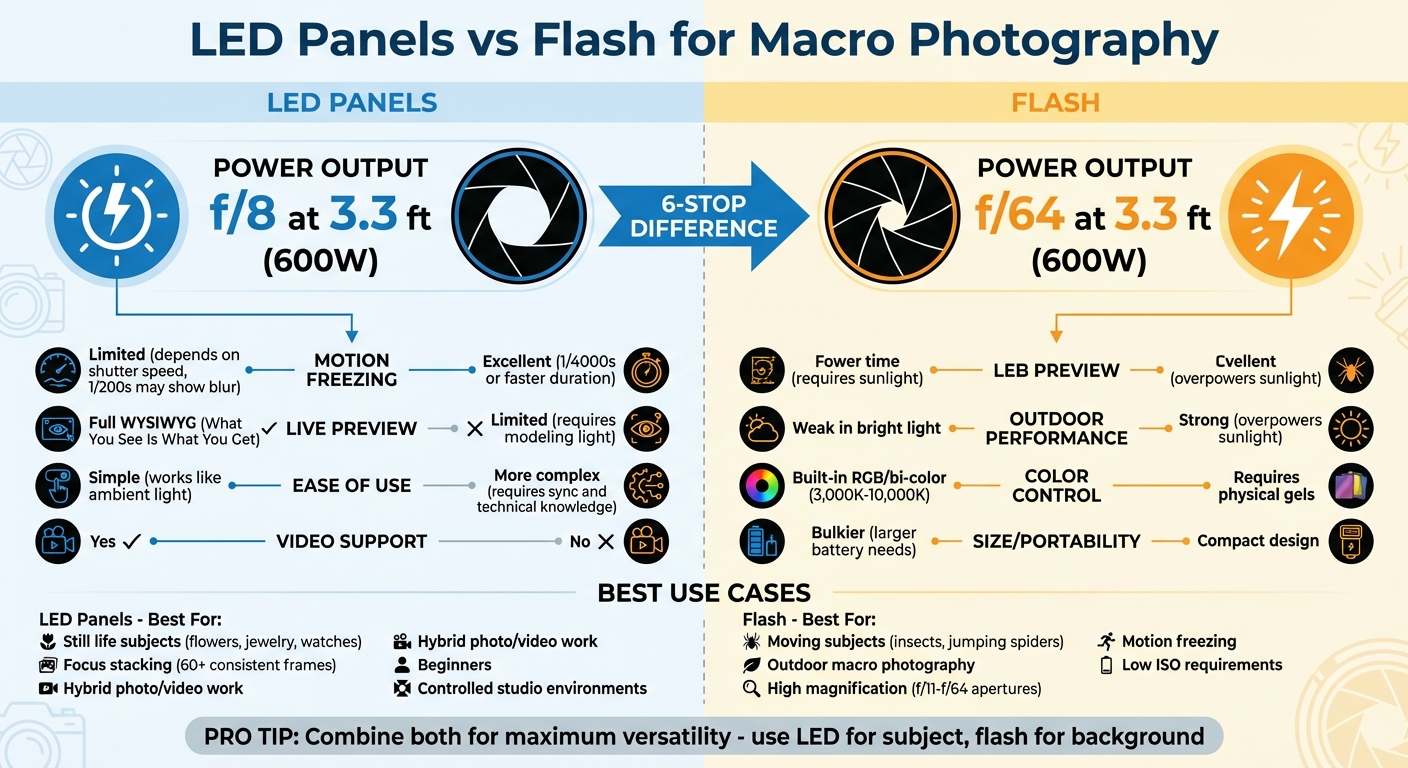
| Power | Lower (f/8 at 3.3 ft) | Higher (f/64 at 3.3 ft) |
| Motion Freezing | Limited | Excellent |
| Live Preview | Full | Limited |
| Ease of Use | Simple | More complex |
| Video Support | Yes | No |
| Outdoor Performance | Weak in bright light | Strong |
Key Takeaway: Use LED panels for controlled, stationary setups and video. Opt for flash when you need power, motion control, or outdoor versatility. For the best results, consider combining both.
LED Panels vs Flash for Macro Photography: Complete Comparison Guide
LED Panels: Pros and Cons
Benefits of LED Panels
LED panels shine when it comes to real-time visual feedback. They let you see exactly how your shot will look before you even press the shutter. Shadows, reflections, and highlights are all visible as you adjust your setup. This "What You See Is What You Get" approach is a game-changer, especially for still life and macro photography, where the tiniest changes in lighting can make a big difference.
Another plus? The learning curve is super manageable. Unlike flash systems, which require syncing and fine-tuning exposure settings, LED panels work like ambient light. This simplicity allows photographers to zero in on framing and subject details without getting bogged down in technical adjustments.
Modern RGB LED panels take flexibility to the next level. With adjustable color temperatures (ranging from 3,000K to 10,000K) and a spectrum of color options, you can quickly adapt your lighting to match your creative vision. As Stefano Tealdi points out:
LEDs allow you to take both photos and videos and switch from one to the other in a few moments.
This adaptability means you can effortlessly switch between stills and video without reconfiguring your setup.
LED panels are also ideal for continuous shooting. Unlike flashes, which need to recycle after each burst, LEDs provide uninterrupted light. This consistency is especially useful for capturing intricate macro details. Plus, their compact size makes it easy to position them close to your macro lens, ensuring precise lighting exactly where you need it.
Drawbacks of LED Panels
Despite their advantages, LED panels come with some notable limitations, particularly in terms of power output and motion control.
The most significant drawback is their limited power output. Compared to flash units, LEDs fall short in delivering intense light. For instance, at a distance of 3.3 feet, a 600W LED panel only achieves an aperture of f/8, while a flash can reach f/64. This often means relying on higher ISO settings, wider apertures (which can reduce depth of field), or slower shutter speeds to achieve the desired exposure.
Another challenge is motion freezing. Flashes excel at freezing movement due to their ultra-short bursts of light, but LEDs depend entirely on your camera's shutter speed. Even at relatively fast speeds like 1/200, motion blur can occur with LEDs. This makes them less effective for capturing moving subjects, such as insects in macro photography.
Finally, outdoor performance is a weak spot. In bright sunlight, LED panels struggle to compete with ambient light, a scenario where flashes perform much better. Additionally, the constant light emitted by LEDs can disturb living subjects, causing them to move or flee before you can get the shot. This can be particularly frustrating when photographing delicate or skittish subjects.
sbb-itb-b27063b
Flash: Pros and Cons
Benefits of Flash
Flash units bring incredible power and precision, making them a go-to choice for macro photography where controlling depth of field and motion is critical.
At just 3.3 feet, a 600W flash can achieve f/64, while a 600W LED panel only reaches f/8 - a six-stop difference. This level of brightness allows photographers to use narrow apertures like f/16 to f/22, ensuring greater depth of field while keeping ISO settings low. Spencer Cox from Photography Life highlights this advantage:
With a flash, my most common exposure will be 1/250 second at f/16 and ISO 100. With a ring light, I would be closer to 1/250 second at f/8 and ISO 800.
Another standout feature is its ability to freeze motion. Flash durations can reach 1/4000s or faster, making it possible to capture sharp images of fast-moving subjects, such as insects. Photographer Jake Hicks emphasizes:
A flash duration of 1/4000s (often even faster) is going to be very useful to you.
When shooting outdoors, flash effectively overpowers ambient sunlight, giving you control over background exposure and shadows. Additionally, its pulsed light can be less disruptive to light-sensitive subjects. As user95069 from Photography Stack Exchange explains:
If you want to have narrow aperture (for getting good depth of field) and high shutter speed (for freezing movement), you need a whole lot of light... you want it pulsed, namely triggered by the camera.
Drawbacks of Flash
Despite its advantages, flash comes with its own set of challenges.
One significant issue is the harsh, hard light it produces. Without proper diffusion, flash can create deep shadows and bright highlights, which are often unflattering for reflective subjects like insects. Wildlife photographer Nicholas Hess cautions:
an undiffused flash is sure to cast harsh shadows and create bright highlights that are usually unattractive.
Balancing flash with ambient light can also be tricky. Most flashes have a fixed color temperature, so matching them to your environment often requires physical gels - a process that Jake Hicks describes as:
a faff at best.
Without a real-time preview, missteps in balancing can result in blacked-out backgrounds or unnatural color tints.
Flash systems tend to be bulkier and more complex compared to LED setups. In extreme close-up photography, a camera-mounted flash might even be blocked by the lens, limiting its effectiveness. Additionally, most cameras have a flash sync speed limit of 1/200 or 1/250 second, which can complicate exposure in bright conditions. Lastly, traditional flash offers no support for video, meaning you'll need separate lighting gear if you plan to shoot both stills and video.
LED Panels vs Flash: Direct Comparison
Comparison Table
After exploring the pros and cons of each lighting type, it’s helpful to see how they measure up side by side. This direct comparison sheds light on their specific strengths and limitations.
For macro photography, understanding the performance gap between LED panels and flash is critical. At a distance of 3.3 feet, using identical settings (ISO 100, 1/200s), a 600Ws strobe produces an impressive f/64, whereas a 600W LED panel only achieves f/8. That’s a difference of 5 to 6 stops, significantly impacting your ability to use narrow apertures for greater depth of field and low ISO settings for cleaner images.
Here’s a breakdown of the key features:
| Feature | Flash (Strobe) | LED Panel (Continuous) |
|---|---|---|
| Power | High (f/64 at 3.3 ft) | Low (f/8 at 3.3 ft) |
| Motion Freezing | Excellent (brief, high-intensity burst) | Limited (depends on shutter speed) |
| Live Preview | Limited (requires modeling light) | Full (What You See Is What You Get) |
| Size/Portability | Compact design | Bulkier with larger battery needs |
| Heat Output | Low (intermittent) | Low (modern LEDs are energy efficient) |
| Color Control | Requires physical gels | Often built-in bi-color or RGB |
| Application | Stills only | Hybrid (stills and video) |
This table makes it clear that each option has its place depending on your creative vision and shooting conditions. Whether you prioritize power and motion freezing or flexibility and live previews, your choice should align with your specific needs.
The Master Preset Bundle: Volume II

$69.00
$990.00
The Master Preset Bundle Volume II New Looks. More Styles. Even More Creative Control. Get 66 brand-new Presets.io collections in one powerful Volume 2 bundle — crafted to expand your editing range, refresh your workflow, and deliver polished, professional results in… continue reading
Macro lighting: LED Vs flash - What's the difference and which is best
When to Use Each Lighting Type
Building on the pros and cons above, here's a breakdown of when each lighting type works best.
Best Situations for LED Panels
LED panels shine in controlled environments where you have time to carefully set up your shot. They’re perfect for still-life subjects like flowers, jewelry, watches, or eyewear - essentially anything that stays stationary during the shoot. This is particularly handy when working with reflective surfaces like glassware or polished metal.
One area where LED panels truly stand out is focus stacking. For intricate subjects, these lights ensure consistent exposure and color temperature throughout the series of shots. Professional photographer Jake Hicks explains:
If you're doing a focus-stacked image of a watch containing 60+ photos, having the exposure and colour exactly the same in all of them saves you an incredible amount of time.
This consistency can save hours of post-processing, eliminating the need to match individual frames manually.
For hybrid creators who switch between macro photography and video, LEDs are indispensable because flash can’t provide the continuous light needed for filming. They’re also great for beginners learning macro photography. Stefano Tealdi, a professional photographer and educator, highlights this advantage:
With LEDs it is like photographing with ambient light, so the non-expert photographer knows how to manage it without problems.
While LED panels dominate in controlled and static setups, flash lighting is unbeatable for dynamic scenarios.
Best Situations for Flash
Flash lighting is unmatched when it comes to freezing motion, making it the go-to choice for capturing active subjects like jumping spiders. Its ultra-short bursts effectively stop both subject movement and camera shake, ensuring sharp details that continuous lighting might struggle with. For insect photography, avoid TTL flash systems, as their pre-flash can spook fast-moving subjects.
When working outdoors, flash provides the raw power needed for macro photography. It’s especially useful for high-magnification shots, where small apertures (f/11 to f/64) are required for adequate depth of field. Flash allows you to maintain a low ISO, preserving maximum detail. Stefano Tealdi explains:
In the studio, even if you use fairly fast shutter speeds (1/200), there may still be motion blur, while with the strobes... the image is always frozen.
Whether you're working in a studio or out in the field, flash lighting is essential for capturing fast-moving subjects and achieving sharp, detailed images.
Choosing the Right Lighting for Your Needs
When deciding between LED panels and flash, your choice largely depends on your subject and shooting style. One key difference to keep in mind is that strobes offer a six-stop power advantage over comparable LED options.
If your work involves stationary subjects like jewelry, flowers, or watches in controlled settings, LED panels are incredibly convenient. They provide a real-time preview of your lighting setup and maintain a consistent color temperature, which is especially helpful for techniques like focus stacking. On the other hand, if you're working with active subjects or shooting outdoors, flash becomes indispensable. Its short pulse duration can freeze motion more effectively than LEDs, and its power allows you to shoot at low ISOs - even at apertures as small as f/64.
Many photographers find that combining both lighting methods yields the best results. For instance, macro photographers often use LED panels to light their subjects while employing flash units to illuminate the background. This hybrid setup offers the precision of LEDs for fine details and the power of flash to prevent backgrounds from fading into darkness. Plus, there are affordable options available for both types of lighting.
For even greater flexibility, hybrid lights like the Rotolight NEO 3 merge continuous LED output with High Speed Sync flash capabilities in a single device. These are especially useful if you frequently switch between macro photography and video or need to adapt your lighting mid-shoot without changing equipment.
In short, choose LED panels for consistent and controllable lighting, flash for freezing motion and raw power, or combine the two for maximum versatility. With these tips, you can confidently select the right lighting to bring your creative ideas to life.
FAQs
What’s the easiest lighting setup for macro beginners?
For beginners in macro photography, the simplest lighting setup involves using a controlled light source that provides even illumination. LED panels are a great option because they’re affordable, user-friendly, and let you preview the lighting before taking a shot. While flash can deliver superior color rendering and faster performance, it’s more complicated to use and often more expensive. This makes LED panels an ideal starting point for those new to macro photography.
How can I get more depth of field with LED panels?
To get more depth of field in macro photography while using LED panels, opt for a smaller aperture (a higher f-number). This setting increases the range of focus, but it also reduces the amount of light hitting the sensor. That’s where LED panels come in handy. Their adjustable, even lighting ensures your subject stays properly exposed, even with the smaller aperture. This way, you can capture sharp, detailed macro shots without worrying about underexposure.
Can I use LED and flash together in one macro setup?
Combining LED panels and flash lighting in a macro photography setup can work exceptionally well. LED panels provide continuous, adjustable lighting, making them perfect for modeling and previewing your shot. On the other hand, flashes deliver powerful bursts of light with better color accuracy, which is crucial for capturing the final image.
This combination is especially effective in studio environments, though it does require careful planning. Syncing the outputs of both light sources is essential to avoid issues with exposure or color consistency. Many photographers rely on LEDs for setting up their composition and use flashes to capture the final shot with precision.